


IT leaders face an increasingly difficult balancing act: keeping business-critical systems running, delivering transformation and preparing for whatever disruption comes next. But with limited resources, competing priorities and growing expectations around AI, how can technology leaders determine what to protect, where to invest and, just as importantly, what to put on hold?
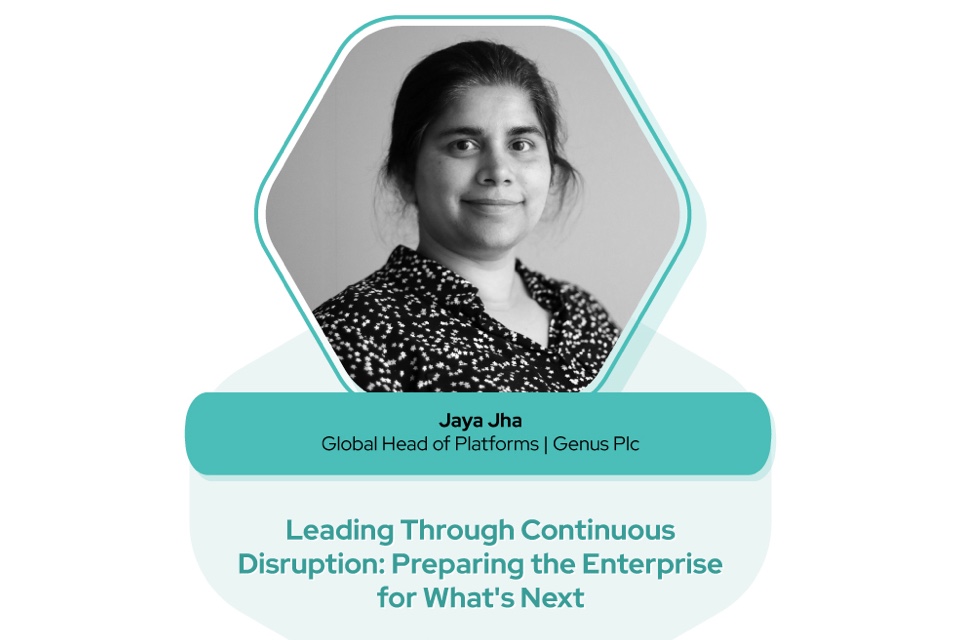
These are among the questions Jaya Jha, Global Head of Platforms at Genus plc, will explore in her session, “Leading Through Continuous Disruption: Preparing the Enterprise for What’s Next,” at the Elevate.Tech Summit on November 10th 2026 at Hilton London Canary Wharf.
With extensive experience leading enterprise systems, data and infrastructure teams across Asia, Europe and the Americas, Jaya brings a practical perspective on managing change while maintaining operational resilience.
Ahead of the event, we spoke to her about the difficult choices facing IT leaders, what successful technology transformation really looks like, and why transparency and accountability are becoming essential as organisations scale their AI investments…
1. What is the hardest leadership choice when disruption becomes continuous?
Deciding what we can responsibly take on, and what must wait. Essential services need to remain dependable while the business expects modernisation and value from emerging technology. Often, the same people support all of that. Leaders need to make the consequences visible: the benefit we expect, the risk of delay and the capacity available. Then we need shared business agreement on what to protect, fund, defer or stop. Adding another priority also means making a choice about existing commitments.
2. How do you respond when disruption comes from outside the organisation?
A recent disruption to access to essential systems reinforced the need to look beyond immediate recovery. Restoring access gave us some space to consider how to reduce dependence on the affected route. That meant understanding which business activities relied on it and which constraints any alternative had to meet. Recovery creates an opportunity to review the operating model. The leadership responsibility is to use that time to improve resilience while keeping the business supported.
3. What tells you that a technology change is ready for the business?
A date is not a plan. I want to understand the dependencies, ownership and evidence behind it. In reporting migration work, technical readiness needs to sit alongside reconciliation and confidence in the data. I have proposed extending transition support where needed, with clear routes to raise issues and recovery options. The aim is to maintain progress while supporting the people using the change. Readiness includes knowing what happens after launch and who remains accountable.
4. What tells you that a technology change has succeeded?
A delivery date needs a plan behind it, including dependencies, ownership and validation. I also look at what happens after delivery. Can the intended users use the change confidently? Does it improve the outcome we agreed? What are people still working around? Those workarounds are useful signals. They may reveal a gap in the system or in our understanding. The right measures depend on the change, including whether the purpose is adoption, reliability or risk reduction.
5. How do you make AI adoption financially accountable as it scales?
I am working on making AI licence and compute costs visible against the departments and business units using them. Licences can be linked to users and organisational ownership. Shared compute needs workload ownership and an agreed allocation basis.
The process matters: reconcile charges to invoices, compare actual spend with budgets and forecasts, and retain the evidence behind allocations and changes. That makes the costs transparent, traceable and auditable.
As adoption changes, those assumptions need review. Cost visibility, alongside evidence of benefit, gives business owners a stronger basis for deciding where to invest, adjust or stop.
6. What would you like participants to take away from your roundtable?
We will compare real decisions where business priorities, limited capacity and changing technology pull in different directions. That includes deciding when to proceed with incomplete certainty, how to accommodate local needs and how to make AI investment accountable.
We will also consider which organizational capabilities need strengthening, so the next disruption is easier to handle.
I want each participant to leave with one decision to revisit in their own organisation, the evidence they need and a clear next step. The value comes from testing our judgement against the experience of other leaders around the table.
Join the Conversation at Elevate.Tech Summit 2026
Jaya will explore these challenges in greater depth at the Elevate.Tech Summit on Tuesday 10 November 2026, where she will lead a discussion on Leading Through Continuous Disruption: Preparing the Enterprise for What’s Next.
Taking place at Hilton London Canary Wharf, the event brings together CIOs, CTOs, CISOs, CDOs, CAIOs and IT Directors for expert-led sessions, peer discussions and pre-arranged one-to-one meetings with relevant solution providers.
With conversations covering AI, cybersecurity, cloud infrastructure, digital transformation and technology leadership, the Summit offers an opportunity to exchange practical insights with peers facing many of the same challenges.
Attendance is complimentary for qualifying senior executives, with places limited.
Find out more about Elevate.Tech Summit 2026 and register your interest.