

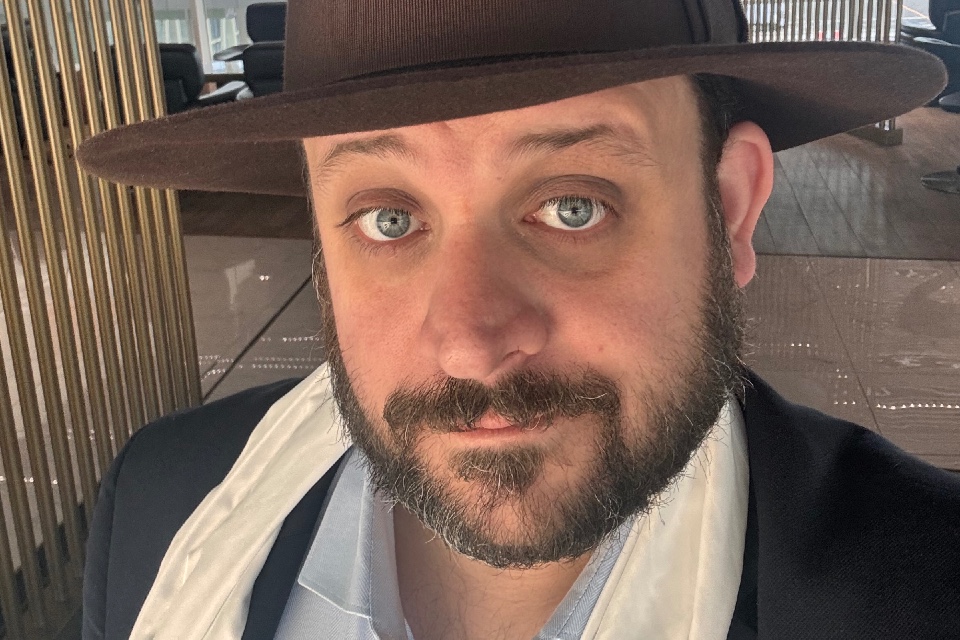
In this edition of 5 Minutes With, mAIself Co-Founder and Elevate.Tech Summit speaker Matthew Wolff Simon discusses the risks of unmanaged AI adoption, the growing importance of cyber awareness across organisations, why quantum computing is fast approaching the security agenda, and how businesses can ensure technology delivers meaningful outcomes rather than simply chasing the latest trend.
Tell us about your company, products and services.
I’m co-founder of mAIself.io, a new kind of AI company: AI for the next billion. Mainstream LLMs are aimed at a narrow linguistic and cultural band of the world – linguistically, at speakers of the top 10 languages, and culturally, at people who are WEIRD: western, educated, individualistic, rich and democratic.
mAIself is aiming at the next billion AI users, providing wider language and cultural support in partnership with communities all around the world – and providing consultancy in AI integration, design and build, global capability and offshoring centres, and technology transformation.
What have been the biggest challenges the IT and cybersecurity industries have faced over the past 12 months?
Of course, readers will have heard the same answer many, many times – AI-orchestrated attacks, agentic infiltration campaigns. What is a bigger challenge is this: organisations seeking productivity have turned wholesale to AI adoption and to giving their employee base as a whole access to develop software without the traditional checks and balances of a properly organised software development lifecycle. Unmanaged IT is more of a cybersecurity challenge than any external attacker will ever be: the call is coming from inside the house.
And what have been the biggest opportunities?
Awareness is the most significant. Cybersecurity has entered the news in a serious way in the last twelve months, moving from a fringe concern for corporate IT teams to a consideration for everyone in the organisation. Likewise, there is an awareness that hardening against social engineering requires more than just a non-interactive online training everyone clicks through. There is much wider awareness of cybersecurity as a three-lines-of-defence issue – appropriate internal controls embedded through the organisation, awareness and vigilance of all team members, and audit.
What are the main trends you are expecting to see in the market next year?
Certainly the AI consultancy market will calm down, in cybersecurity and more widely, as companies prioritise business results over technological novelty. There really is no such thing as ‘AI consultancy’ – there is consultancy, there is business change, and there are technological tools to enable it.
What technology is going to have the biggest impact on the market this coming year?
Quantum computing without a doubt, which is an existential risk to traditional cybersecurity and encryption frameworks. We are already seeing a rise in bad actors harvesting data now with the aim of decrypting later. Quantum computing also provides new opportunities in threat detection and remediation.
Next year we’ll all be talking about…?
The latest high profile intrusion or data leak. Greater attack surface will inevitably come from widespread adoption of AI – which is why it’s vital to secure AI tooling and SDLC.
Which person in, or associated with, the IT and Cyber Security industries would you most like to meet?
Kevin Mitnick is, unfortunately, no longer with us, but he would have been my first choice – social engineering was and remains a top vector for intrusion for years and it will always remain with us in one form or another. He developed social engineering to a fine art form and wrote and spoke on social engineering and penetration testing extensively.
I would also like to meet Peter Sommer, expert witness and academic who, under the name Hugo Cornwall, wrote the Hacker’s Handbook and Corporate Espionage Handbook, which I read many times as a teenager.
What’s the most surprising thing you’ve learnt about the IT and Cyber Security sectors?
There are many cyber security sectors; the certification space, responsibilities of CISOs, so many things vary from person to person and environment to environment.
You go to the bar at the Elevate.Tech Summit – what’s your tipple of choice?
As the Secretary of the Bristol Tbilisi Association I am bound to tell you Georgian wine. The most famous wine is saperavi and justly so. I am also very fond of tsolikouri grapes which make the semi-sweet white wine tvishi, and I have had a wonderful tsolikouri vinegar in salad.
What’s the most exciting thing about your job?
mAIself is building for something entirely new. We are AI for the next billion, focusing on languages outside of the big global languages, and cultures outside of the WEIRD (Western, Educated, Individualist, Rich and Democratic) norm. We are working to create something new, lasting and of value – in IT, where sometimes the stakes can be a little vague, creating something significant is exhilarating…
And what’s the most challenging?
…but hard. This is building from nothing, creating something high risk and distinct. And that means convincing journalists, investors, and the public. Everything in life is sales of a kind.
What’s the best piece of advice you’ve ever been given?
An old boss of mine – a guy called Jo – asked a very simple question, one that I use constantly and which I use with everyone – junior and senior – all the time. “What is the problem you are trying to solve?” This is the key to everything. Work out what you are really trying to do, and do that.
Succession or Stranger Things?
I haven’t actually seen either! I don’t watch much TV, as I’m working through ‘1000 Movies You Must See Before You Die’. This is the first age, ever, where this is possible. When I was 17, I waited months to order the DVD of Metropolis. I can now find it online in minutes
To learn more about the Elevate.Tech Summit, click here.